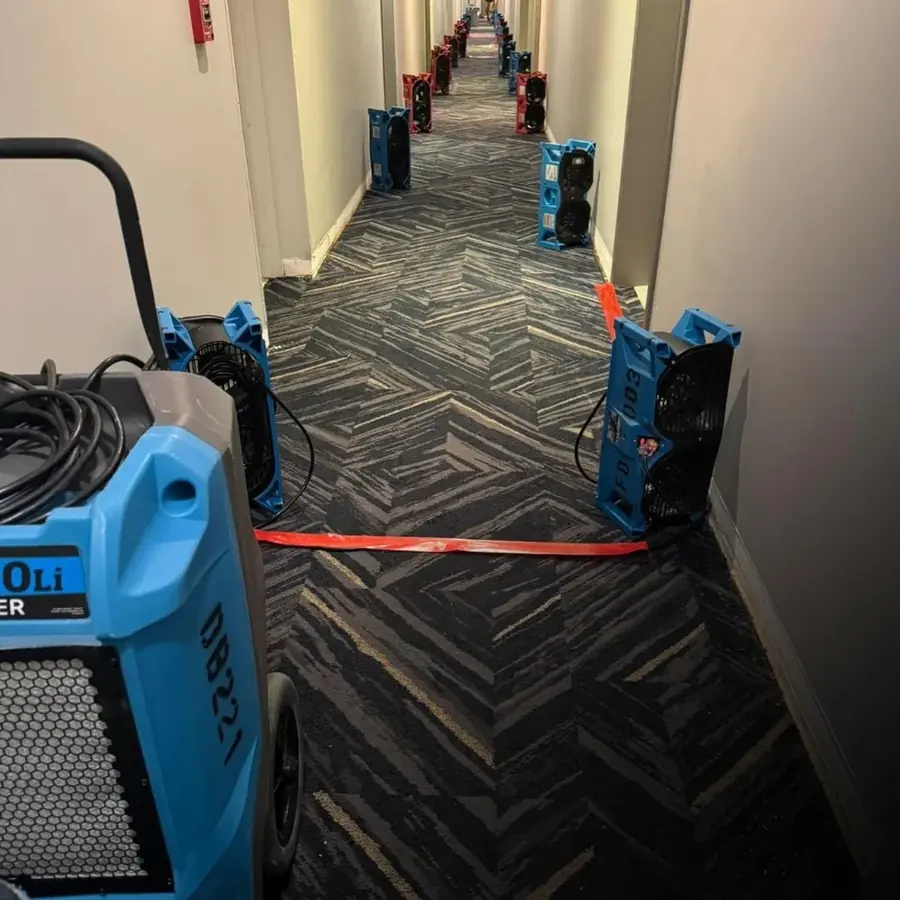
How the crew handles structural drying & dehumidification in Atlanta
Call & dispatch
A real person answers 24/7 and the nearest Atlanta crew rolls with truck-mounted pumps, air movers, and moisture meters.
On-site assessment
The crew finds the source and the full reach of the water, including what soaked into subfloor, wall cavities, and crawl space.
Extract & dry
The extraction crew pulls the standing water, then runs air movers and dehumidifiers to a verified dry standard, not just the surface.
Verify & document
The drying team logs moisture readings until the structure is dry, then documents the loss for your insurance claim.
Pulling the standing water out is only half the job. The water you cannot see, soaked into framing, subfloor, drywall, and a concrete slab, is what warps a floor and feeds mold weeks later. Structural drying is the science of removing that hidden moisture and proving it is gone, and it matters even more in Atlanta's humid climate.
How professional structural drying works
Local crews dry homes with commercial equipment and daily monitoring, not a box fan and hope. Drying follows the IICRC S500 standard for applied structural drying, so meter readings, not guesswork, tell when a home is truly dry.
Real drying balances three things at once, and missing any one just moves the water around the room instead of removing it:
- Airflow from high-velocity air movers sweeps moisture off wet surfaces into the air.
- Dehumidification with LGR units pulls that moisture out of the air before it soaks into dry material elsewhere.
- Temperature is held in a range that keeps the whole process fast and steady.
A reading on wet material is checked against a dry standard from an unaffected part of the same home. Only when the two match is the job finished, and the crew logs that standard for your insurance file.
Drying in Atlanta's humidity
Atlanta sits in a humid subtropical climate with long muggy summers and high dew points. That humidity is why opening the windows or running a box fan fails here, because the outdoor air is often wetter than the air you are drying.
Leftover moisture is where mold begins, and in this climate it can start within 24 to 48 hours. The EPA guidance on mold and moisture and the CDC guidance on mold are blunt that the key is moisture control. Professional dehumidification, sized to the room and material, is the only reliable way to beat that clock indoors.
What crews dry in Atlanta homes
The crew moisture maps every wet material first, then matches the equipment to what got wet, following IICRC standards for applied structural drying:
- Hardwood floors can often be saved with specialty drying mats when a crew reaches them fast, instead of being torn out.
- Drywall and insulation hold water low in the wall, so the crew dries the cavity in place where the material is sound.
- A concrete basement slab and block foundation hold enormous amounts of water and are the slowest part of any job on Atlanta red clay.
- Crawl space framing and old plaster dry unevenly and need careful monitoring.
Drying time, mold prevention, and insurance
Most Atlanta dry outs run three to five days, but the real answer depends on how much water there was, what got wet, and how long it sat. A finished basement with a soaked slab takes longer than a single wet wall. The drying time estimator gives a rough idea, and a crew confirms it on-site.
The drying phase is a standard line item on a water claim, so insurers expect and pay for professional equipment and monitoring. The restoration team documents the daily readings and final standard for your claim. Whether the water came from the extraction crew, a flooded basement, or elsewhere, the crew sees it through to a verified finish so the mold remediation team never has to get involved.
Water left in your walls does not wait in Atlanta's humidity. Call now and a crew is on the way.
☎ Call (678) 586-7595Why Atlanta homes dry slowly
Two things make a local dry out harder than the label on a rental fan suggests. First, the humid subtropical air holds so much moisture that a room can feel dry to the touch while the framing stays wet for weeks. Second, so many intown homes sit on a concrete slab or a vented crawl space over dense red clay that releases water slowly. Getting a Grant Park basement or a Kirkwood crawl space truly dry takes commercial dehumidification and daily readings, not time and a couple of fans.
Why Atlanta calls the local pros first
Rapid local response
The response team answers 24/7, and the nearest crew heads out the moment you call, any hour, anywhere across metro Atlanta.
IICRC S500 drying standard
Trained crews run truck-mounted pumps, air movers, and moisture meters, drying to a verified standard, not a mop and a bucket.
Claim-ready documentation
The loss is documented with photos and daily moisture readings, the paperwork an adjuster needs to move a claim.
Local water experts
Red clay basements, vented crawl spaces, combined sewers, and creek floodplains, the local pros know how water moves in Atlanta.
From Buckhead to the West End, the whole city
From the Historic Westside, crews respond across the City of Atlanta and the intown ring, day or night.
From the Historic Westside, local crews cover the City of Atlanta and the intown ring across Fulton and DeKalb, day or night.
Coverage includes Buckhead, Midtown, Virginia-Highland, Grant Park, East Atlanta, Kirkwood, the West End, the Historic Westside, Decatur, Brookhaven, and Sandy Springs.
See every neighborhood and ZIP covered ›Related restoration services
Common questions, answered
How long does structural drying take in Atlanta?
Most Atlanta dry outs run three to five days. The real time depends on how much water there was, what got wet, and how long it sat. A soaked basement slab or old plaster dries slower than a single wet wall, and the local humidity adds time.
Can I just run fans and a box dehumidifier in this humidity?
For a small fresh spill, maybe. For anything larger, no. Household gear cannot reach moisture inside walls or a slab and cannot confirm the structure is dry, and Atlanta's humid air often undoes the little drying it does.
How do you know when it is truly dry?
The crew sets a dry standard from unaffected materials in your home, then meters the wet areas every day until they match it. The equipment comes out only when the readings confirm it, and the crew documents that standard for your file.
Do you dry inside walls without tearing them out?
Often, yes. With early access the crew can dry a wall cavity in place using controlled airflow and specialty equipment, which saves the drywall. If material is contaminated or too far gone, removing it is faster and safer.
Does drying prevent mold?
It is the single most important step. Mold needs moisture and can start within 24 to 48 hours in this climate. Drying the structure quickly and completely to a verified standard is what stops mold before it begins.
Will insurance pay for the drying equipment?
Usually, yes. Professional drying and monitoring are a standard, expected line item on a water claim. The restoration team documents the daily readings and the final standard, with direct billing to your carrier where coverage applies.
Do you dry hardwood and slab without ruining them?
Yes, that is a large part of the work here. The crew uses floor drying systems to save hardwood that would otherwise be pulled up, and commercial dehumidification to draw water out of a concrete slab over time.
How much does the drying phase cost?
It depends on the number of air movers and dehumidifiers, the days of monitoring, and the size of the wet area. The crew gives a clear scope before starting. Call (678) 586-7595 and someone will walk you through it.
Atlanta's water damage crew is ready when you are
Water sitting means damage spreading. Call Diamond Atlanta and a local crew heads out across metro Atlanta, day or night.
(678) 586-7595Call now, a live Atlanta dispatcher picks up any hour